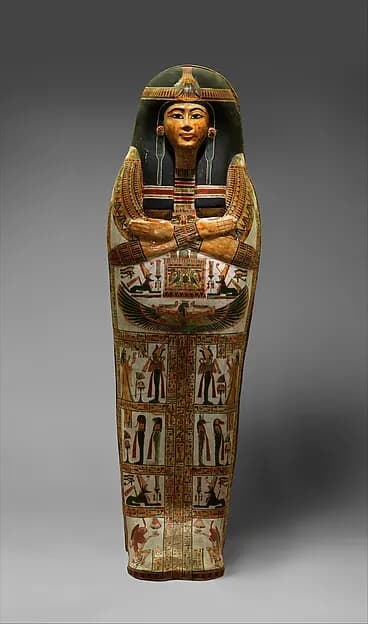
Henettawy sang for Amun-Re. Her outer coffin is loud with that job. Yellow varnish, crowded gods, and the face of a woman who expects to be recognized in the next world. Third Intermediate Period coffins often feel denser than Middle Kingdom ones. The night has more furniture.
Amun-Re is hidden sun and visible sun at once. A chantress is a person whose work is to make the hidden audible. The coffin is the last venue. If the voice cannot go, the images still perform.
This is why funerary art belongs next to a planet named for a messenger. Messages continue when the speaker cannot. Henettawy’s coffin is not a metaphor for an app. It is a historical technology for keeping a name in circulation among gods.
Stand far enough away and the coffin is a golden rectangle. Come closer and it is a crowd. Egyptian afterlife is social. You do not travel the Duat alone if the painters did their work. The Temple of Thoth hangs this as a reminder that the night journey is a procession.