Mercury 91 is not affiliated with The Metropolitan Museum of Art. Images and object data shown here are public-domain Open Access (CC0) records from The Met collection. Citations are given so you can visit each work on the museum site.
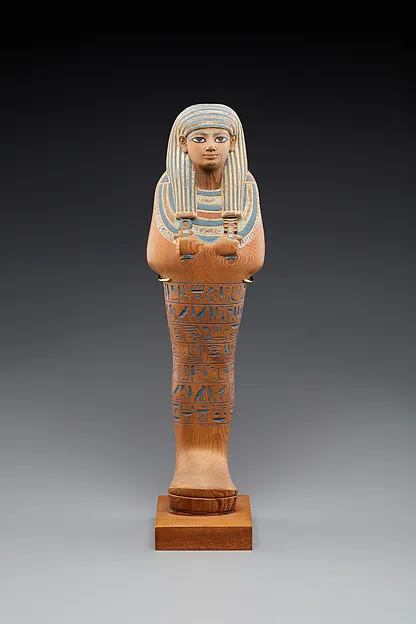
Shabtis are stand-ins. If the gods call the dead to farm the fields of the next world, the figure answers. Yuya was the father of Queen Tiye, grandfather of Akhenaten. His burial equipment is court quality. Even a labor proxy gets a fine face.
The idea is both tender and bureaucratic. Eternity has a workforce. The wealthy pack extra hands. That is not a joke in the original religion. It is ethics plus anxiety: you might still be asked to work, and you would rather be ready.
In a cosmic gallery the shabti is a small astronaut. It is a body designed for a place you have not reached. The difference is that Egyptian next-world geography was mapped in spells, not in vacuum. Both are about sending a representative ahead.
Yuya’s family sits at the hinge of the Amarna revolution. This figure is still orthodox New Kingdom. Looking at it before Akhenaten’s duck relief is a way to feel the old contract: many gods, many workers, one name that must not be lost.
Citation
Shabti of Yuya. ca. 1386–1347 BCE. Cedar, paint, Egyptian blue. The Metropolitan Museum of Art, New York. 30.8.57. Theodore M. Davis Collection, Bequest of Theodore M. Davis, 1915
Public-domain Open Access (CC0) photograph. Dimensions: H. 28.5 cm (11 1/4 in.); w. at elbows 7.8 cm (3 1/16 in.); d. at foot 5.4 cm (2 1/8 in.)