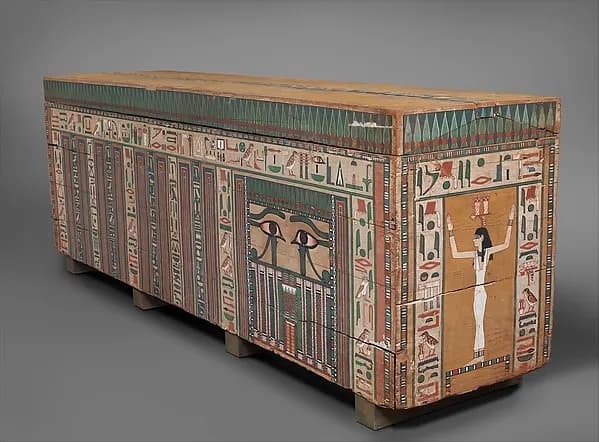
Middle Kingdom coffins are houses. The deceased lies inside a miniature cosmos: offering formulas, eyes that look toward dawn, and texts that keep the name attached to the bones. Khnumnakht’s coffin is that architecture in paint and wood.
A coffin is the most intimate sky object in Egyptian art. You do not visit it like a temple courtyard. You are meant to be the contents. That inversion is useful in a 3D universe. Planets are bodies you fly around. A coffin is a body you cannot enter without metaphor. The gallery asks you to look at the painted exterior as a map of care.
Khnumnakht’s name includes the god Khnum, the potter who fashions people on a wheel. Creation and burial share craft language. The coffin is another fashioned body around the first one.
In the colonnade of the Temple of Thoth this piece reads as a wall. It is a vertical painting that once lay horizontal over a person. Turning it upright for a gallery is already an interpretation. We keep the citation honest so the original use is never forgotten.