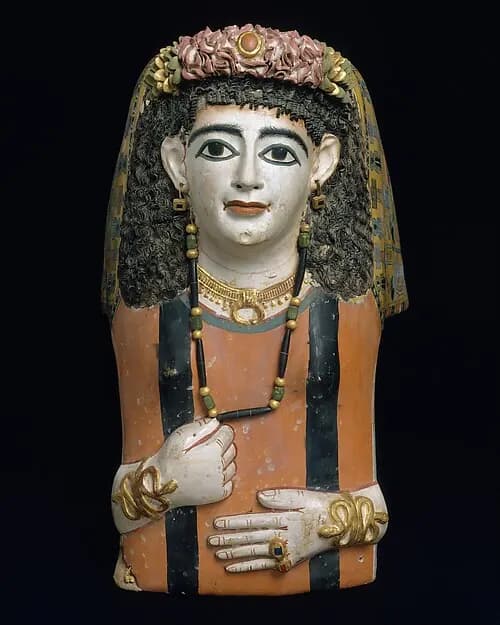
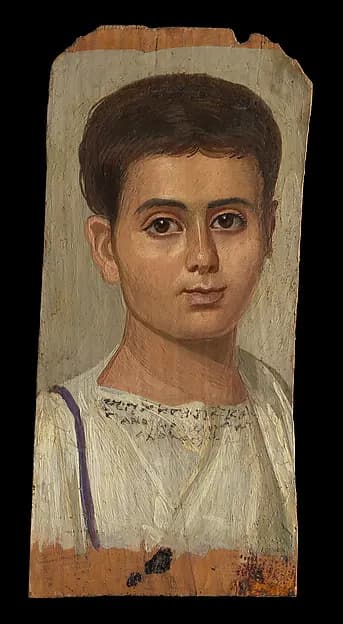
Portrait of the Boy Eutyches, 100–150 CE, The Metropolitan Museum of Art

Egyptian artPortrait of the Boy Eutyches

100–150 CE · Roman Period

The mummy portrait of the boy Eutyches is Roman Egypt looking back at you: encaustic skin on a still-Egyptian burial.

Mercury 91 is not affiliated with The Metropolitan Museum of Art. Images and object data shown here are public-domain Open Access (CC0) records from The Met collection. Citations are given so you can visit each work on the museum site.

Fayum portraits are the shock of naturalism after millennia of ideal faces. Eutyches is a child with a specific mouth. He is also a mummy portrait, made to be bound over a wrapped body. Greek name, Egyptian death, Roman-period paint.

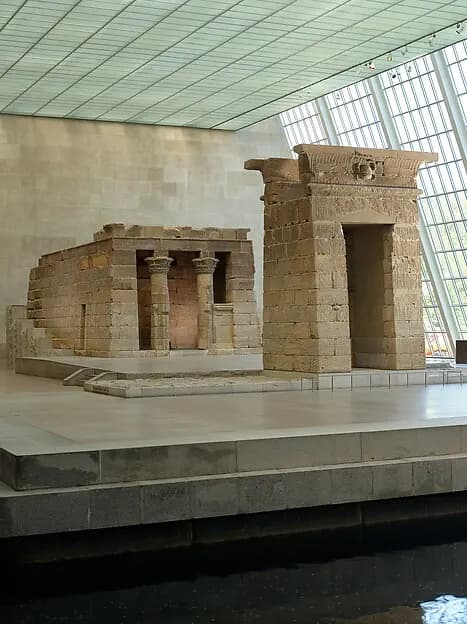
That hybrid is the end of this catalog’s timeline. Dendur is Augustan architecture. Eutyches is Augustan-era looking. Egypt is still Egypt, and the face has learned a new grammar.

People often call these the first true portraits. Egyptian art had always portrayed. What changed is the invitation to believe in oil-and-wax individuality. The invitation works. It is hard not to feel you could recognize him in a street.

Hang him last in the period walk. After sphinxes and spells, a boy. The night journey did not get simpler. It got a face you might dream without trying.
Citation

Portrait of the Boy Eutyches. 100–150 CE. Encaustic on wood. The Metropolitan Museum of Art, New York. 18.9.2. Gift of Edward S. Harkness, 1918

Public-domain Open Access (CC0) photograph. Dimensions: h. 38 cm (14 15/16 in); w. 19 cm (7 1/2 in)

Temple of Thoth in the 3D universe · Back to the Egyptian art gallery