Mercury 91 is not affiliated with The Metropolitan Museum of Art. Images and object data shown here are public-domain Open Access (CC0) records from The Met collection. Citations are given so you can visit each work on the museum site.
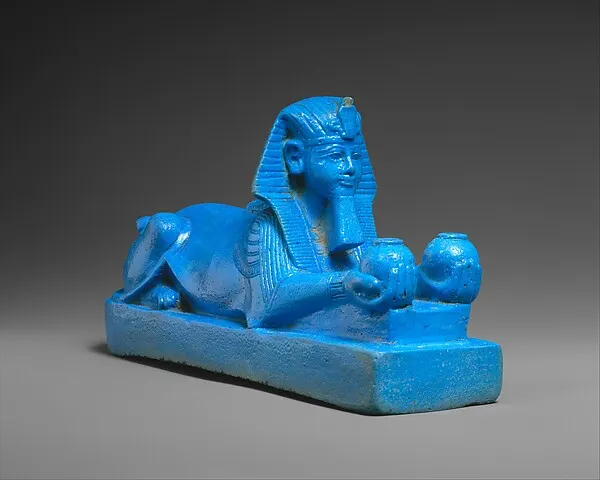
Not every sphinx is an avenue monster. Some are models, votives, or pieces of larger furniture. This sphinx still does the full symbolic work: human head, lion body, solar king. It just does it at a scale you could imagine on a table of offerings.
Amenhotep III loved lions and loved being a lion. His mortuary temple once bristled with them. A small sphinx is a souvenir of that appetite.
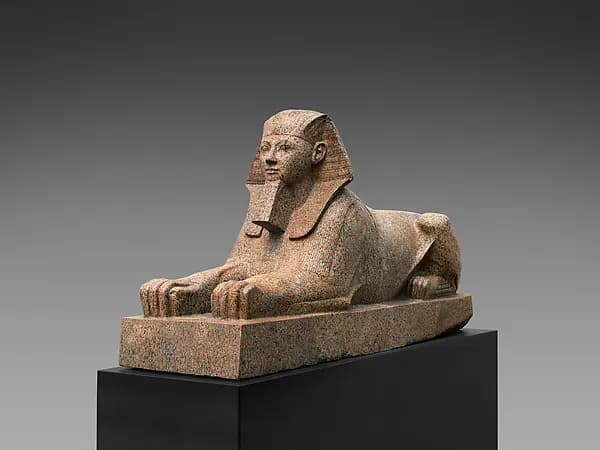
Place it beside Hatshepsut’s larger sphinx in your head. Same animal sentence, different volume. Egyptian art repeats because repetition is how a cosmos stays true.
The Temple of Thoth uses small objects as seriously as colossal ones. A model sphinx is perfect for a compact court in orbit. It is already a miniature monument. We do not have to shrink a pylon to make the metaphor work.
Citation
Sphinx of Amenhotep III, possibly from a Model of a Temple. ca. 1386–1347 BCE. Faience, remains of a travertine (Egyptian alabaster) tenon. The Metropolitan Museum of Art, New York. 1972.125. Purchase, Lila Acheson Wallace Gift, 1972
Public-domain Open Access (CC0) photograph. Dimensions: l. 25.1 cm (9 7/8 in); w. 13.3 cm (5 1/4 in); h. 13.3 cm (5 1/4 in)