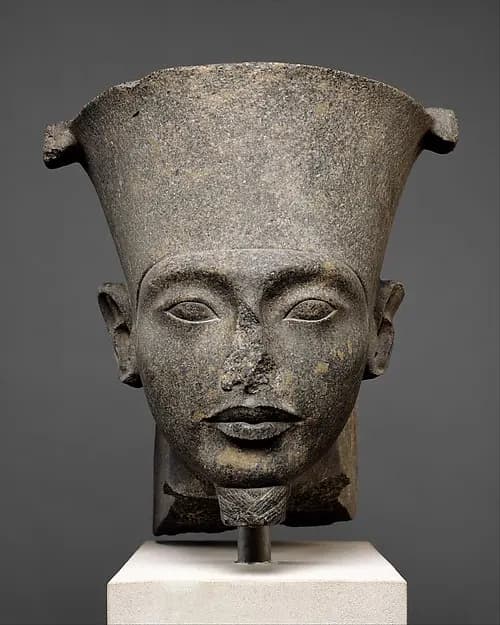
Head of the god Amun, ca. 1328–1318 BCE, The Metropolitan Museum of Art

Egyptian artHead of the god Amun

ca. 1328–1318 BCE · New Kingdom, post-Amarna Period · Dynasty 18

A fragmentary head of Amun keeps the god’s face after the crown is gone: recognition without the full costume of Thebes.

Mercury 91 is not affiliated with The Metropolitan Museum of Art. Images and object data shown here are public-domain Open Access (CC0) records from The Met collection. Citations are given so you can visit each work on the museum site.

Without the tall plumes, Amun is a face. That is a useful reduction. Cult depends on recognizing the god when the festival equipment is incomplete, which is the state of almost every museum object.

The modeling still says divinity: idealized, calm, slightly more than human. Compare Khafre’s fragment. One is a king. One is a god. Both survive as heads because heads are what we keep when buildings fall.

Amun’s hiddenness is ironic on a page with a photograph. We are looking. The theology said he was not easily looked at. Art is the licensed exception.

The colonnade uses this head as a dark star among brighter narrative pieces. Not every stop in a temple is a story. Some are presence.
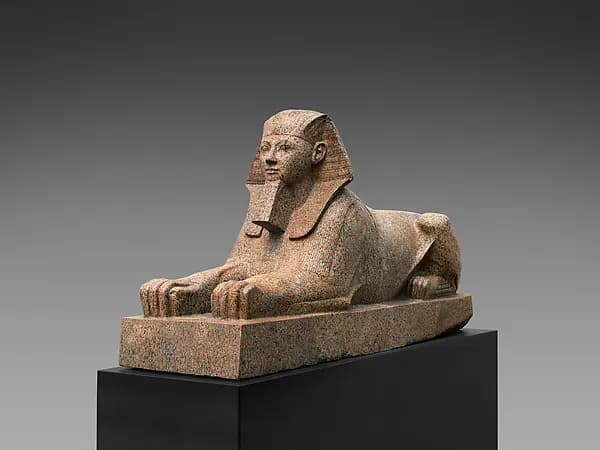
Citation

Head of the god Amun. ca. 1328–1318 BCE. Granodiorite. The Metropolitan Museum of Art, New York. 07.228.34. Rogers Fund, 1907

Public-domain Open Access (CC0) photograph. Dimensions: H. 44 cm (17 5/16 in.), W. 38.2 (15 1/16 in.); D. 41.5 (16 5/16 in.)

Temple of Thoth in the 3D universe · Back to the Egyptian art gallery