Mercury 91 is not affiliated with The Metropolitan Museum of Art. Images and object data shown here are public-domain Open Access (CC0) records from The Met collection. Citations are given so you can visit each work on the museum site.
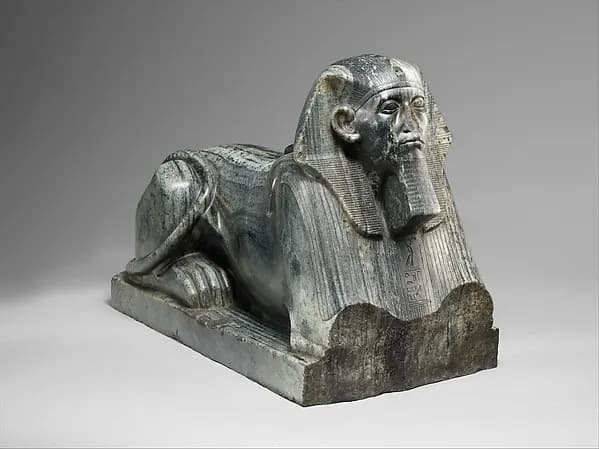
Middle Kingdom kings, especially Senwosret III, allowed age and tension into the royal face. The ears are large. The mouth is set. The lion body still says invulnerability. The head says the king has seen the work.
That combination is rare in earlier Old Kingdom calm. It is one reason this sphinx belongs in a gallery about attention. A messenger planet is fast. This face is slow. The contrast is the point.
Senwosret III campaigned in Nubia and reorganized Egypt’s internal control. The tired-king look may be ideology as much as portrait: a ruler who labors. Ideology still uses a real chisel. You can feel the cheek planes.
In the colonnade he watches Hatshepsut from another dynasty. Sphinx to sphinx, two centuries of the same animal sentence, rewritten in a more anxious grammar.
Citation
Senwosret III as a Sphinx. ca. 1878–1840 B.C.. Gneiss. The Metropolitan Museum of Art, New York. 17.9.2. Gift of Edward S. Harkness, 1917
Public-domain Open Access (CC0) photograph. Dimensions: L. 73 × W. 29.5 × H. 42.5 cm, 114.3 kg (28 3/4 × 11 5/8 × 16 3/4 in., 252 lb.)