Mercury 91 is not affiliated with The Metropolitan Museum of Art. Images and object data shown here are public-domain Open Access (CC0) records from The Met collection. Citations are given so you can visit each work on the museum site.
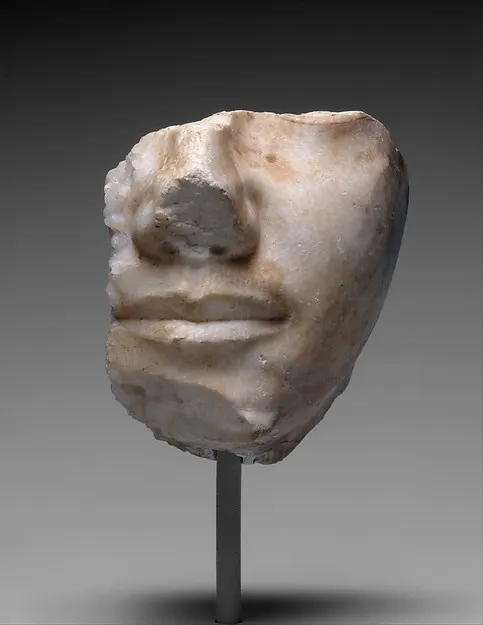
Khafre built the second pyramid at Giza and is the king most often linked to the Great Sphinx. This fragment is not that monument. It is a piece of a statue face. Enough remains to feel the Old Kingdom formula: composure as cosmic order.
Fragments are honest teachers. Most Egyptian sculpture in the world is incomplete. A gallery that only shows whole masterpieces lies about survival. Khafre here is a mouth that still governs a room.
Old Kingdom royal faces are the opposite of Senwosret’s lines. They argue that the king is a constant, like the sun’s daily circuit. The fragment lets you test that claim at the scale of a few centimeters of stone.
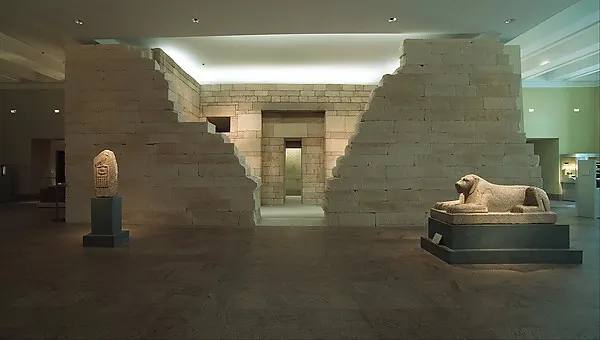
Place it early in the period walk on this hub. Giza is the deep past of the Temple of Thoth hang, even though our 3D court is small. The essay’s job is to keep the scale difference visible: a universe next to a shard.
Citation
Fragmentary Face of King Khafre. ca. 2520–2494 BCE. Travertine (Egyptian alabaster). The Metropolitan Museum of Art, New York. 26.7.1392. Purchase, Edward S. Harkness Gift, 1926
Public-domain Open Access (CC0) photograph. Dimensions: H 8 × W 7.3 × D 9.5 cm (3 1/8 × 2 7/8 × 3 3/4 in.)