Mercury 91 is not affiliated with The Metropolitan Museum of Art. Images and object data shown here are public-domain Open Access (CC0) records from The Met collection. Citations are given so you can visit each work on the museum site.
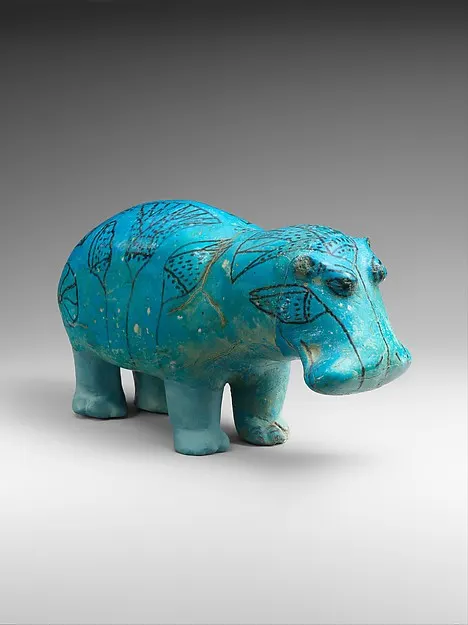
Hippos were hunted and feared. They also became protective figures in tombs, often painted with lotus and marsh plants as if the animal were a walking landscape. William is the famous example, named by museum staff in the twentieth century. The nickname is modern. The danger is ancient.
Faience blue-green is Nile color. The hippo is a lump of river that can still bite. Egyptian art likes that double register: cute at a distance, lethal in the water.
Why is a hippo in the inner court of a Thoth temple? Because the gallery is not only priests. It is Egypt as a world that includes animals who do not care about your spells. William is the comic relief that is still theology. Marsh plants on the body are the environment sticking to the beast.
People remember William. That popularity is an SEO fact and a human fact. The essay still has to earn its keep: this is a river god’s cousin, not a toy, and the citation belongs to The Met, not to a mascot franchise.
Citation
Hippopotamus ("William"). ca. 1961–1878 B.C.. Faience. The Metropolitan Museum of Art, New York. 17.9.1. Gift of Edward S. Harkness, 1917
Public-domain Open Access (CC0) photograph. Dimensions: L. 20 cm (7 7/8 in.); W. 7.5 cm (2 15/16 in.); H. 11.2 cm (4 7/16 in.)