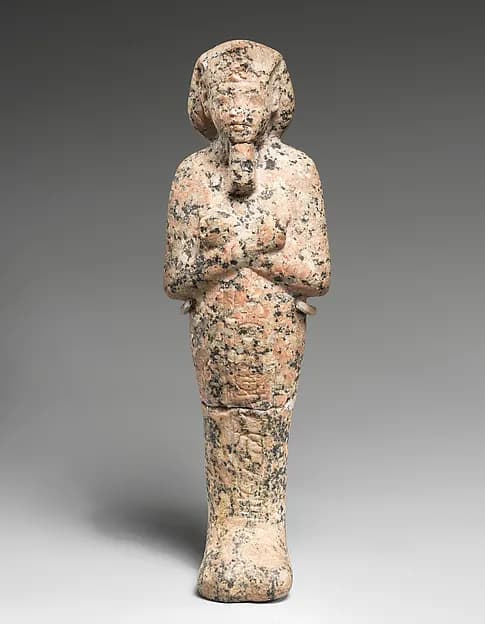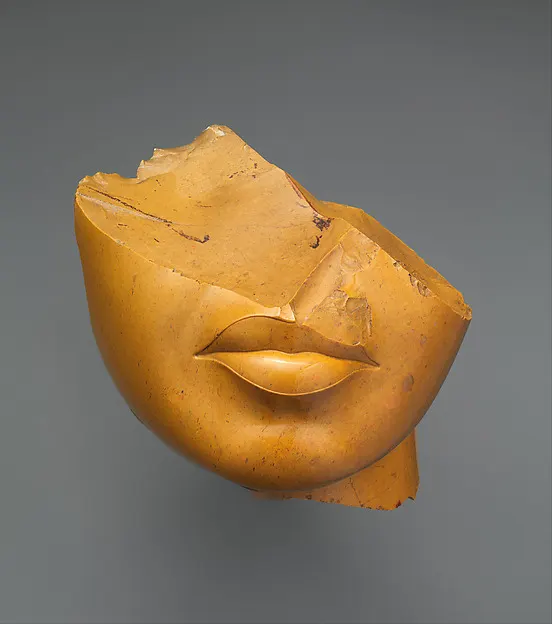
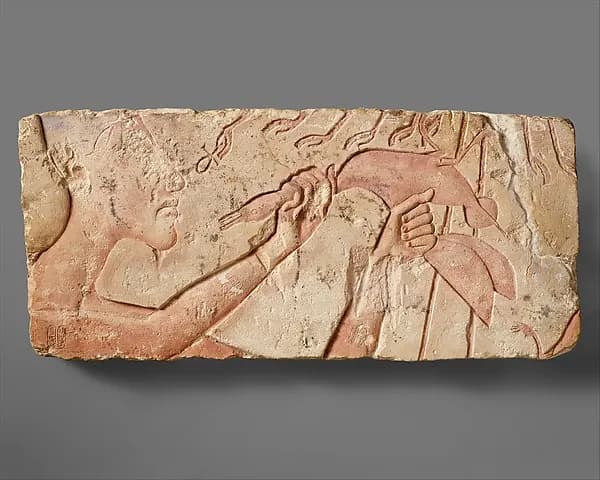
Amarna art broke the old body canon. Akhenaten’s skull, belly, and long fingers were a theological style. The Aten, shown as a sun disk with tiny hands, touches the offering. A duck is not a trivial gift. It is a life given to light.
This relief is a compact manual of the heresy. No crowded pantheon. No ibis Thoth in the scene. The king mediates. That is why the piece is essential in a Thoth-centered gallery. It is the interruption. For a generation, the scribe-god’s world was officially dimmed in favor of a single radiating disk.
The disk with hands is already a cosmic diagram. Rays are not decoration. They are the physics of the new cult: light as the only legitimate touch. Mercury 91 can show that without turning it into modern sun-worship copy. It is a historical experiment in reducing the sky to one actor.
Look at the duck. Amarna intimacy is famous for family scenes. Here intimacy is sacrificial. The king’s hands and the Aten’s hands almost complete a circuit around a bird. The relief is a wiring diagram of devotion.