Mercury 91 is not affiliated with The Metropolitan Museum of Art. Images and object data shown here are public-domain Open Access (CC0) records from The Met collection. Citations are given so you can visit each work on the museum site.
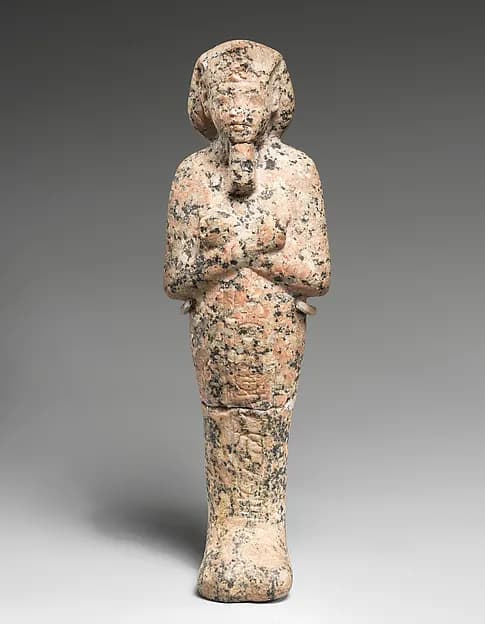
Even a king who rebuilt religion still needed funerary equipment. This figure keeps Amarna proportions while serving an older job: a stand-in in the next world. Reform rarely deletes logistics.
That tension is the essay. Akhenaten changed the sky’s staff list. He did not stop being a body that would die. The object is where revolution meets the undertaker.
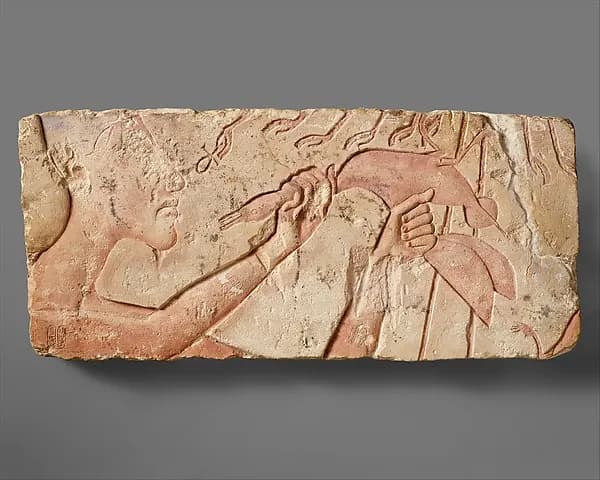
Compare the duck relief. One is cult in action. One is cult after the action fails, as all bodies fail. Together they bookend Amarna as a human timescale, not only as an art style.
In the Temple of Thoth this figure stands in the colonnade, not the inner court. The inner court keeps Thoth, Hatshepsut, Nauny, William, the ceiling, Perneb, and Dendur. Amarna is the argument in the aisle: what happens when the old gods are told to wait.
Citation
Funerary Figure of Akhenaten. ca. 1347–1330 BCE. Granite. The Metropolitan Museum of Art, New York. 1982.50. Gift of Mr. and Mrs. Jack A. Josephson, 1982
Public-domain Open Access (CC0) photograph. Dimensions: H. 27 × W. 8.2 × D. 7 cm (10 5/8 × 3 1/4 × 2 3/4 in.)